All 8 HYROX stations in race order, official Open and Pro weights (sled push 102–202 kg), muscles worked, common mistakes and how to train each.
Ready to put it into practice? Discover our HYROX class in Marrakech.
Want to try?
Your 1st session here to guide you through every exercise.
A HYROX race repeats the same loop eight times: run 1 km, then complete one functional workout station. Station two, the sled push, is the one most beginners worry about. Station eight, the wall balls, comes when your legs have almost nothing left.
This guide covers all 8 HYROX stations in race order. For each one you'll find what you do, the official weight for your division, the mistakes we see most often and how to train it. New to the sport? Start with our guide What is HYROX?.
The 8 HYROX stations in race order
The official format fits in one line: run 1 km, do one station, repeat eight times. Here are the order and distances HYROX publishes:
| # | Station | Distance or reps |
|---|---|---|
| 1 | SkiErg | 1000 m |
| 2 | Sled push | 50 m (2 × 25 m) |
| 3 | Sled pull | 50 m (2 × 25 m) |
| 4 | Burpee broad jumps | 80 m |
| 5 | Rowing | 1000 m |
| 6 | Farmers carry | 200 m |
| 7 | Sandbag lunges | 100 m |
| 8 | Wall balls | 100 reps |
HYROX weights by division
Everyone covers the same distances. Only the load changes. These are the official singles weights (for the sled push and sled pull, the weight includes the sled):
| Station | Open women | Open men | Pro women | Pro men |
|---|---|---|---|---|
| Sled push | 102 kg | 152 kg | 152 kg | 202 kg |
| Sled pull | 78 kg | 103 kg | 103 kg | 153 kg |
| Farmers carry | 2 × 16 kg | 2 × 24 kg | 2 × 24 kg | 2 × 32 kg |
| Sandbag lunges | 10 kg | 20 kg | 20 kg | 30 kg |
| Wall balls | 4 kg | 6 kg | 6 kg | 9 kg |
The SkiErg, burpee broad jumps and rowing have no load to choose. HYROX also runs Doubles (two athletes) and Relay (teams of four) divisions. The movement standards for each station are in the official rulebook, so read it before your first race.
1. SkiErg: 1000 m
The SkiErg is a machine where you pull two handles down, like a cross-country skier driving their poles. It is the first station, right after the first kilometre.
The most common mistake is going out too fast. You feel fresh, the adrenaline is up, and your arms are cooked before you reach the sled.
The power comes from your hips and core as much as your arms. Start tall with your arms almost straight, then hinge at the hips and bend your knees slightly as you pull. Stand back up and let the handles rise.
To train it:
- 250 m intervals at race pace with short rest;
- one full 1000 m each week to learn a steady pace;
- core work, because your trunk carries the force through to the handles.
2. Sled push: 50 m
The sled push means driving a loaded sled 50 m, in two lengths of 25 m. In the Open division it weighs 102 kg for women and 152 kg for men, sled included. For many beginners, this is where the most time goes.
So what muscles does the sled push work? Mostly your quads, helped by your glutes, hamstrings and calves. Your core holds your body in line between your legs and the sled. Your shoulders and arms work too, more or less depending on your elbows: your triceps do more with straight arms than with bent ones.
The classic mistake is standing too upright. Your body pushes up instead of forward, and the sled stops moving.
This is the position that works:
- torso leaning forward, close to horizontal, hips low;
- arms straight or slightly bent on the poles. Straight arms pass more leg drive into the sled. Bent arms get you closer and keep your angle lower. Try both;
- short, fast steps, driving the floor behind you through the balls of your feet;
- never stop completely, because getting a dead sled moving again takes far more effort than keeping it going.
To train it, build leg strength first with squats, lunges, leg press and step-ups. Add heavy pushes over short distances to practise the start. Then push at race weight straight after a hard run interval, so you learn to push on tired legs.
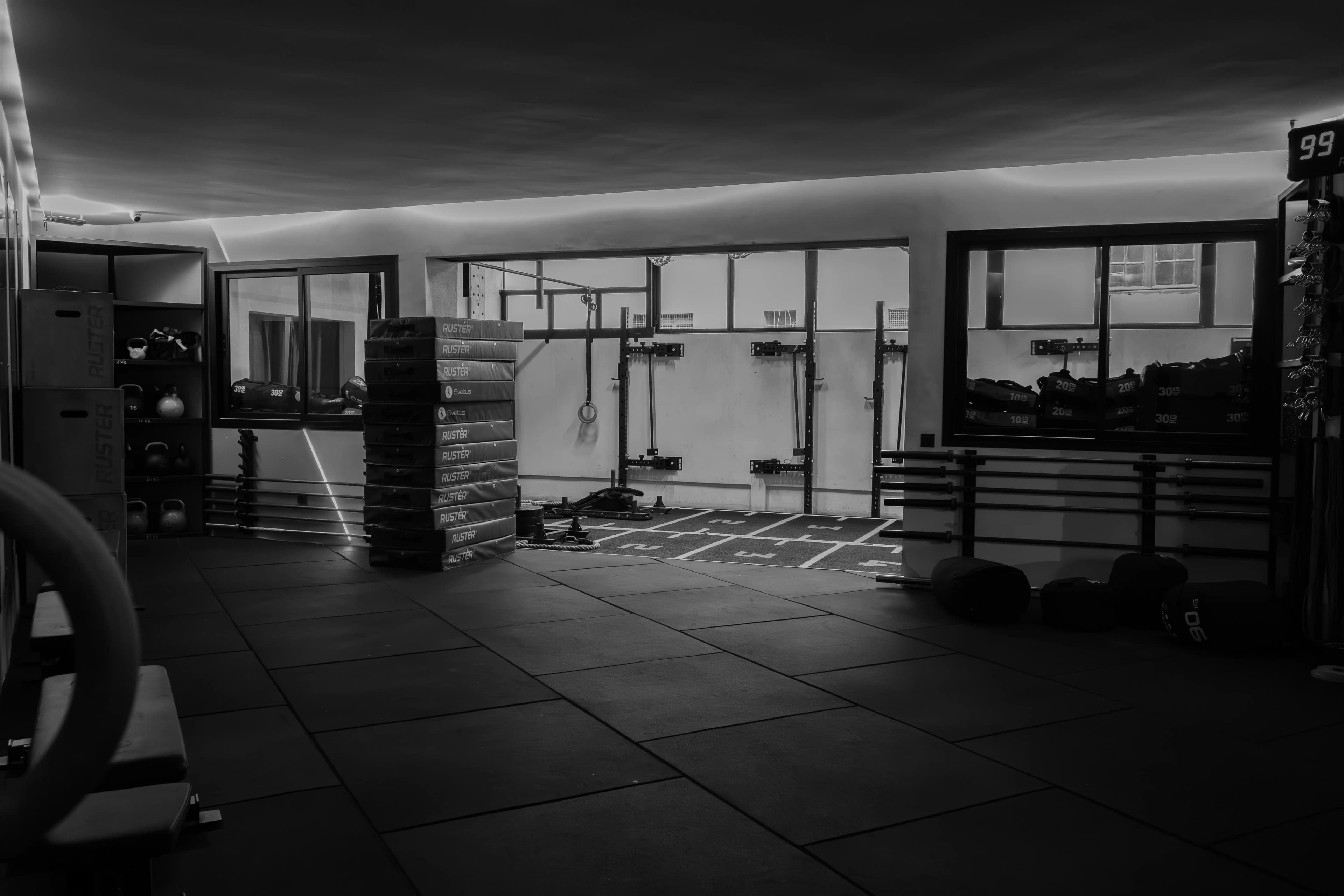
In our HYROX classes, members train the sled push at 100 to 150 kg depending on their level. The HYROX class runs for 60 minutes with 12 people at most, at our studio in Gueliz, and first-timers get scaled loads and shorter distances from the coach.
3. Sled pull: 50 m
Right after the push, you pull the sled towards you with a rope, again over 2 × 25 m. In Open it weighs 78 kg for women and 103 kg for men, sled included.
A lot of people pull with their arms only. The arms give out within a few metres, and the grip goes with them.
Step back once or twice as you pull so your legs and body weight do the work. Your arms keep the rope moving, hand over hand, in long pulls without jerking. Keep the slack rope tidy so you don't trip on it.
To train it:
- horizontal pulling (dumbbell rows, low cable rows) for your back;
- grip work: dead hangs from a bar, heavy kettlebell holds;
- sled push into sled pull, back to back, as in the race.
4. Burpee broad jumps: 80 m
One burpee, then a two-footed broad jump forward, and repeat until you've covered 80 m. There's no weight and no difference between divisions, but your heart rate goes through the roof.
We often see huge jumps at the start, then a collapse. Over 80 m, medium, steady jumps finish faster than a heroic opening.
Lower yourself to the floor under control, bring your feet back under your hips, then jump with a strong arm swing. Find a rhythm you can hold without stopping.
To train it, do sets over 20 or 40 m with short rest, and keep longer cardio sessions in your week: this station is mostly about breathing.
5. Rowing: 1000 m
The rower comes at the halfway point. Many athletes use it to settle their breathing, but a poor stroke quickly costs seconds.
The usual mistake is pulling with the arms first. On a rower the order is legs, then torso, then arms. On the way back, reverse it: arms, torso, legs.
Aim for a strong leg drive, a moderate stroke rate and a steady rhythm. Strong, controlled strokes usually beat fast, weak ones.
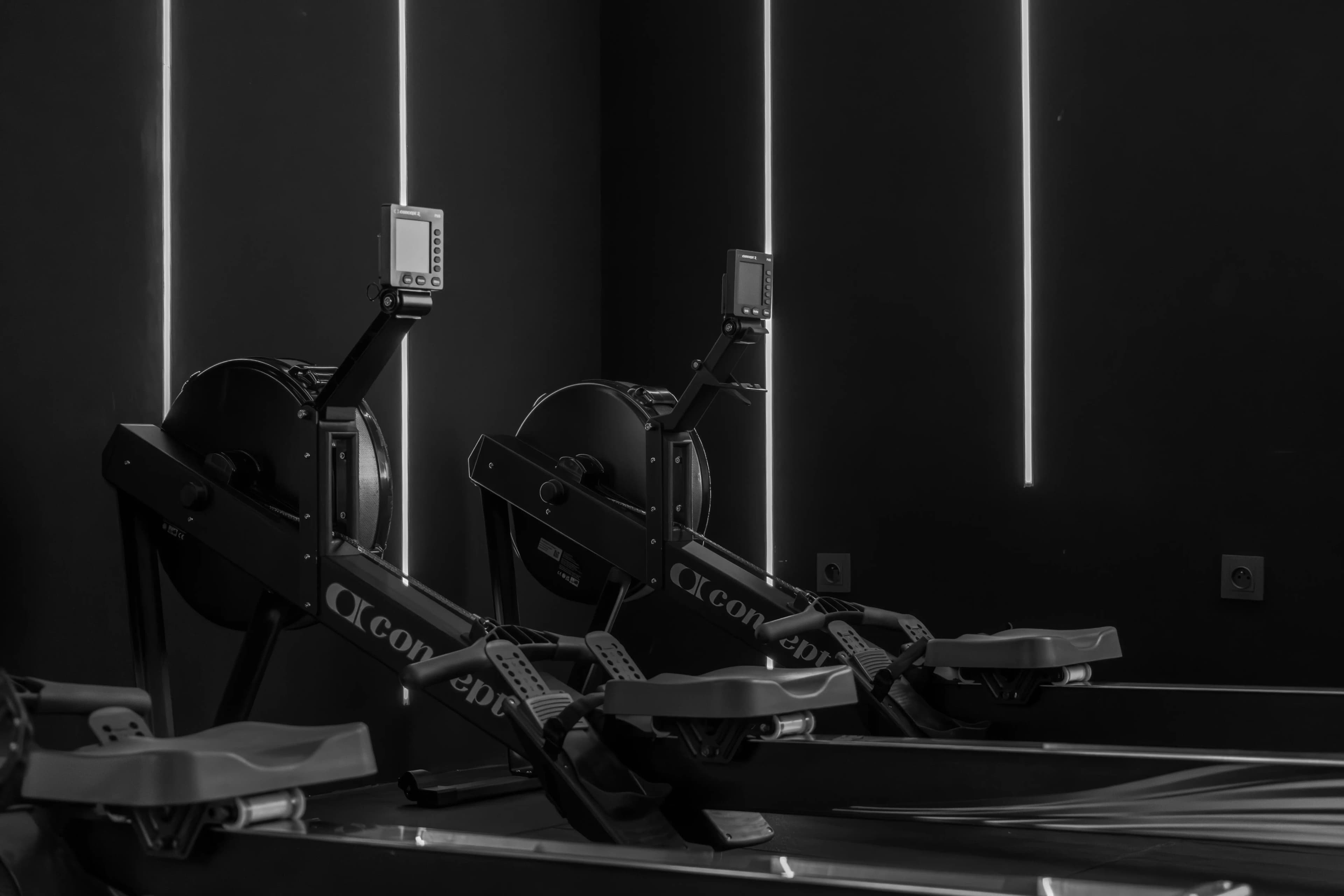
To train it, do repeated 500 m pieces at race pace, and keep technique sessions at a low stroke rate to clean up the legs, torso, arms sequence. Our classes use Concept2 rowers.
6. Farmers carry: 200 m
You walk 200 m with a kettlebell in each hand: 2 × 16 kg for Open women, 2 × 24 kg for Open men. Grip is the problem, and it is already tired from the sled pull.
Every time you put the kettlebells down, you lose time picking them up again. That's the mistake that costs most here.
Keep your shoulders down and back, chest up, and take short, quick steps. If you need to put them down, do it before your grip fails.
To train it, do heavy carries over 50 to 100 m, plus bar hangs and static holds for grip.
7. Sandbag lunges: 100 m
Walking lunges over 100 m with a sandbag on your shoulders: 10 kg for Open women, 20 kg for Open men. After six stations and seven kilometres, your quads decide how this one goes.
Steps that are too long tire you fast. Steps that are too short cost you balance and range.
Find an even step, keep your torso upright and the bag sitting firmly on your shoulders, at a pace that lets you keep moving. The exact movement standard is in the official rulebook.
To train it, do loaded walking lunges in long sets, and lunges straight after a run so your legs get used to working tired.
8. Wall balls: 100 reps
The final station: squat holding a medicine ball, stand up and throw it to a target on the wall, 100 times. In Open, the ball weighs 4 kg for women and 6 kg for men.
By now your legs are already very tired. Athletes who start with big sets often end up pausing after every few reps.
What helps:
- squat all the way down, ball held against your chest;
- throw with your leg drive as well as your arms;
- break the 100 reps into fixed blocks, for example 10 sets of 10, with rests of a few breaths.
To train it, do back and front squats for leg strength, sets of wall balls at the end of a session when you're already tired, and 100-rep tests to find the split that suits you.
How to train all 8 stations together
Mastering each station alone is not enough, because on race day you have to link running and stations without blowing up. A good training week mixes three things:
- Strength (squats, lunges, pulls, grip), so the loads feel lighter on race day.
- Endurance, with regular running, since there are 8 km in total.
- Race simulations, run then station, repeated, to learn pacing and transitions.
That third point is how the Dune Training HYROX class works: a 40-minute main block that alternates 400 to 800 m treadmill runs with the stations.
For a week-by-week plan, read our HYROX training programme for beginners. To find out where to race in Morocco, see our HYROX Morocco guide.
FAQ
How heavy is the HYROX sled push?
In singles, the sled push is 102 kg for Open women, 152 kg for Open men and Pro women, and 202 kg for Pro men. These weights include the sled. The distance is 50 m for everyone, in two lengths of 25 m.
What muscles does the sled push work?
Mainly the quads, along with the glutes, hamstrings and calves. Your core holds the position, and your arms and shoulders join in depending on whether you push with straight or bent elbows.
What is the hardest HYROX station?
It depends on your profile. Runners often struggle with the sled push and sled pull, which need strength. Stronger, heavier athletes usually find the lunges and wall balls harder, because they come at the end of the race with almost all the running already in their legs.
Do I need to be fit to do HYROX?
HYROX recommends having a fitness background or training regularly. You must be 16 or over, and there is no time limit to finish the race.
Can I train the sled push without a sled?
Squats, lunges and step-ups build the leg strength. To learn the position and rhythm, though, nothing replaces a real sled. Our Gueliz studio has sleds, plus a SkiErg, Concept2 rowers, wall balls, kettlebells and sandbags, and the HYROX class provides all of it. To book a first session, message us on WhatsApp or drop by the studio at 60 Avenue Mohammed V.
Train for the HYROX stations in Marrakech
At Dune Training in Gueliz, our HYROX class recreates race conditions. Each session lasts 60 minutes, with a maximum of 12 people: a 10-minute warm-up, then the 40-minute main block of treadmill runs and stations. The studio provides the sleds, SkiErg, Concept2 rowers, wall balls, kettlebells and sandbags.
The class is open to all levels. Beginners work with adjusted loads and distances, and the coach corrects your technique in real time. The coach also times the stations and records results, so you can track your progress week to week.
Classes fill up fast. See the Dune Training HYROX class, then book your first session on WhatsApp or in person at 60 Avenue Mohammed V.